
M&A & Corporate Finance
Global cross-border M&A and infrastructure opportunities across key sectors
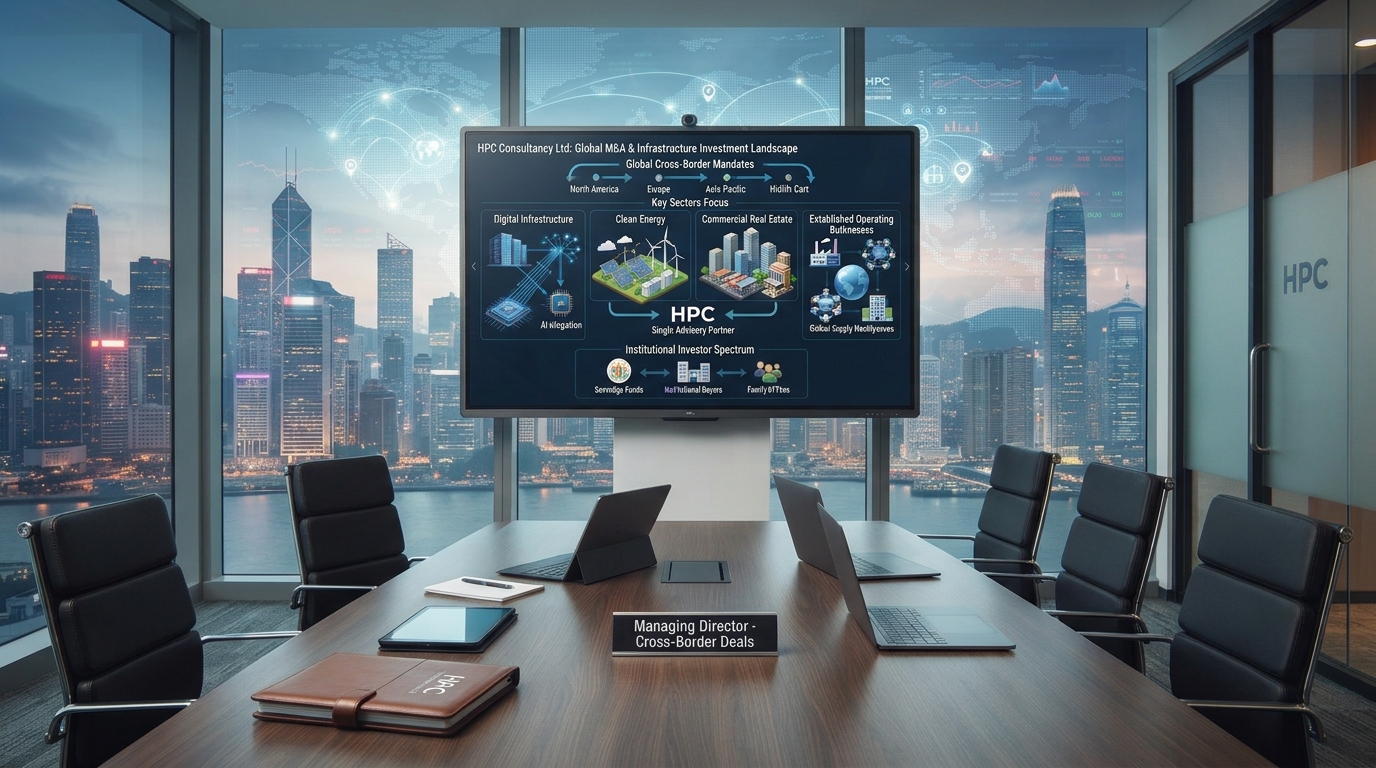
Institutional buyers, sovereign funds, and family offices face an increasingly complex deal environment. Across global capital markets, investors are balancing sovereign debt yields, corporate bond tender offers, and private equity continuation vehicles alongside rapid shifts in artificial intelligence and energy infrastructure. HPC Consultancy Ltd acts as a single advisory partner for both buy-side and sell-side mandates across commercial real estate, digital infrastructure, clean energy, and established operating businesses worldwide.
Operating businesses and institutional platforms available for acquisition
Acquiring established enterprises with recurring cash flows and strong market positioning remains a core priority for international capital. Our advisory practice connects qualified principals with vetted sell-side opportunities and executes buy-side searches across diverse commercial sectors.
-
Hospitality and healthcare assets include luxury hotels for sale and established private hospitals for sale across major international destinations and emerging growth hubs.
-
Professional services and financial platforms feature profitable consulting companies for sale alongside scalable digital investment platforms ready for institutional capital or strategic expansion.
-
Industrial and technology enterprises cover specialist semiconductor suppliers, frontier AI labs, and corporate carve-outs of non-core engineering or aerospace divisions.
Clean energy and digital infrastructure land parcels
The rapid expansion of artificial intelligence compute capacity and national decarbonisation targets has created intense competition for power-ready land and energy generation assets. HPC structures acquisitions, joint ventures, and project finance mandates across critical infrastructure categories.
-
Digital infrastructure opportunities span pre-built data centre capacity, hyperscale AI data centre land parcels, and high-voltage power interconnection assets.
-
Renewable energy assets include pre-permitted grid-connected battery storage units, utility-scale solar land, wind land, and Southeast Asian hydropower capacity.
End-to-end buy-side and sell-side transaction advisory
Executing multi-jurisdictional transactions requires strict confidentiality, disciplined valuation modelling, and smooth regulatory coordination. Whether you are divesting an operational business, monetising permitted energy land, or deploying capital into an international acquisition, HPC manages the entire deal lifecycle from initial screening and buyer credentialing through commercial negotiation and closing.
If your Ireland organisation is looking to acquire or divest hotels, hospitals, consulting firms, investment platforms, data centres, clean energy land, or technology assets, contact the HPC advisory team today to discuss your mandate.
Frequently asked questions for international investors on global M&A and infrastructure mandates
1. How does HPC act as a one-stop advisory partner for buy-side and sell-side transactions?
HPC manages the full transaction lifecycle across commercial real estate, operating companies, and energy infrastructure, handling target identification, buyer credentialing, commercial structuring, and confidential deal execution under one roof.
2. What types of operating businesses does HPC currently represent for sale?
HPC advises on active sell-side mandates including hotels for sale, private hospitals for sale, established consulting companies for sale, and scalable digital investment platforms.
3. Can HPC represent buyers looking to acquire clean energy land and power assets?
Yes, HPC provides dedicated buy-side and sell-side advisory for pre-permitted grid-connected battery storage and offshore wind energy assets, solar land, wind land, and hydropower projects.
4. How do Ireland wealth management buyout targets and cross-border private equity co-investments fit into HPC's advisory scope?
HPC connects international institutional buyers and family offices with Ireland wealth management buyout targets and cross-border private equity co-investments, structuring equity partnerships and governance frameworks for long-term growth.
5. What opportunities exist in spot-purchase SME loan portfolios and non-performing consumer credit books?
Private credit investors work with HPC to evaluate spot-purchase SME loan portfolios and non-performing consumer credit books, structuring risk-adjusted acquisitions backed by thorough collateral and cash-flow audits.
6. How do Lloyd's of London specialty insurance platforms and insurance-linked capital structures attract international capital?
Global investors use Lloyd's of London specialty insurance platforms and insurance-linked capital structures to access uncorrelated underwriting yields alongside specialty broker consolidation.
7. How does HPC assist buyers targeting undervalued FTSE 250 public companies and investment trust share buyback programmes?
Advisory teams analyse undervalued FTSE 250 public companies and investment trust share buyback programmes to help institutional sponsors structure take-private buyouts and strategic equity stakes.
8. What role do bulk annuity pension risk transfer mandates and longevity reinsurance deals play in institutional capital flows?
Bulk annuity pension risk transfer (PRT) mandates and longevity reinsurance deals free up insurer balance-sheet capacity and channel long-duration capital into infrastructure, data centres, and private credit.
9. How can corporate buyers acquire non-core UK industrial, engineering, and defence divisions?
HPC structures corporate carve-outs of non-core UK industrial, engineering, and defence divisions, separating standalone operational units from parent conglomerates for strategic or private equity buyers.
10. What investment potential do AI-native biotech and life sciences spinouts offer institutional venture allocations?
AI-native biotech and life sciences spinouts for institutional venture allocation combine proprietary computational models with clinical drug pipelines, creating high-margin acquisition targets for global pharmaceutical groups.
11. How does commercial real estate debt restructuring and prime logistics warehouse refinancing create entry points?
Commercial real estate debt restructuring and prime logistics warehouse refinancing allow well-capitalised buyers to acquire distressed hospitality, healthcare, or industrial properties at disciplined valuations.
12. How do secondary private equity LP stakes and GP-led continuation vehicles support long-term asset holding?
Secondary private equity LP stakes and GP-led continuation vehicles, alongside credit secondaries and single-asset continuation vehicles such as Moelis advising on the $1.2 billion EisnerAmper continuation vehicle, provide liquidity options while retaining high-performing infrastructure and healthcare assets.
13. How do corporate bond tender offers and liability management exercises affect cross-border M&A financing?
Active debt optimisation, seen in corporate bond tender offers and liability management exercises following Solvay SA accepting €376 million in bonds under its tender offer alongside concurrent euro note pricing, helps corporate acquirers refinance balance sheets efficiently.
14. How do European government bond yields and sovereign debt market liquidity influence infrastructure valuations?
Shifts in European government bond yields and sovereign debt market liquidity, highlighted at the AFME European Government Bond Conference in Brussels, establish benchmark discount rates for pricing long-term solar, wind, and data centre cash flows.
15. How do accelerated institutional equity private placements fund industrial and environmental technology firms?
Accelerated institutional equity private placements in circular-economy and industrial tech firms, such as Envipco's overnight bookbuilding, enable mid-market growth companies to raise expansion capital rapidly.
16. Why are pre-built data centre capacity and high-voltage power interconnection assets in high demand?
Pre-built data centre capacity and high-voltage power interconnection assets eliminate multi-year grid connection delays, making them prime acquisition targets for hyperscale cloud operators and AI labs.
17. What drives institutional investment into European defence, dual-use aerospace, and autonomous systems manufacturers?
Rising security budgets fuel capital deployment into European defence, dual-use aerospace, and autonomous systems manufacturers, following Lakestar co-leading Tiberius Aerospace's $85 million Series A.
18. How does insurance broker consolidation across DACH markets create buy-and-build value?
Insurance broker consolidation and capital-light managing general agent (MGA) platforms across DACH markets allow private equity sponsors to aggregate regional brokerages into high-margin national platforms.
19. How do Solvency II capital treatment rules and bank balance-sheet risk transfers affect private credit availability?
Solvency II capital treatment for collateralised loan obligation (CLO) debt tranches and non-performing loan (NPL) portfolios and bank balance-sheet risk transfers expand institutional appetite for structured corporate and real estate debt.
20. What regulatory filings are critical for large cross-border European acquisitions?
Cross-border M&A merger control and EU Foreign Subsidies Regulation filings require early legal preparation so international buyers can clear competition and state-backing reviews smoothly.
21. How do semi-liquid evergreen private market funds expand private wealth participation?
Semi-liquid evergreen private market funds for European wealth distribution channels give private wealth platforms continuous access to infrastructure, private equity, and real estate mandates.
22. What opportunities exist in semiconductor materials buyouts and corporate divestitures?
Semiconductor materials buyouts and corporate divestitures, led by Japan Investment Corp.'s $8.2 billion planned sale of JSR Corporation to Mitsui Chemicals, allow strategic buyers to secure critical chip supply chain technologies.
23. How does HPC support Southeast Asian data centre expansion projects and cross-border infrastructure arbitration frameworks?
HPC advises developers and funds on Southeast Asian data centre expansion projects and cross-border infrastructure arbitration frameworks, ensuring enforceable legal protections and reliable power procurement.
24. How do multi-currency Asian bond issuances and Asia-Pacific trading desk expansion support regional deal flow?
Multi-currency Asian bond issuances by global corporate borrowers and Asia-Pacific trading desk expansion and institutional market-making infrastructure in Singapore and Hong Kong deepen regional liquidity for cross-border M&A.
25. Why are hyperscale AI data centre land parcels and Southeast Asian hydropower capacity paired together?
Combining hyperscale AI data centre land parcels and Southeast Asian hydropower capacity provides AI labs and cloud operators with scalable, low-carbon baseload electricity at competitive tariff rates.
26. How can investors access pre-IPO late-stage secondary blocks and Japanese corporate governance activist targets?
Pre-IPO late-stage secondary blocks in Asian tech and consumer conglomerates and Japanese corporate governance activist targets and conglomerate asset sales unlock prime equity stakes and non-core corporate divestitures across Asia.
27. What role do cross-border supply chain manufacturing facilities in Vietnam, India, and Malaysia play in global industrial M&A?
Cross-border supply chain manufacturing facilities in Vietnam, India, and Malaysia offer diversified production bases for electronics, automotive, and clean energy hardware manufacturers.
28. How do tokenised wholesale bank deposits and foreign currency hedging tools improve cross-border closings?
Tokenised wholesale bank deposits and distributed ledger capital market settlement rails, paired with monitoring foreign currency intervention thresholds and USD/JPY cross-currency basis swaps, reduce settlement friction and currency risk on international deals.
29. What signals strong capital market appetite in East Africa for industrial and infrastructure assets?
Oversubscribed East African industrial rights issues and capital market equity listings, such as TOL Gases' 129.4% oversubscribed rights issue listing on the Dar es Salaam Stock Exchange, demonstrate robust local and institutional demand for essential industrial businesses.
30. How do long-term port concessions and African mineral processing mandates create investment opportunities?
Long-term port and logistics terminal concessions backed by sovereign and international operators and domestic mineral processing and local value-addition mandates across critical mineral jurisdictions attract strategic infrastructure and industrial capital.
31. How can international buyers acquire Tier-1 copper, cobalt, and critical mineral mining concessions?
HPC assists vetted mining groups and industrial off-takers in evaluating Tier-1 copper, cobalt, and critical mineral mining concessions for strategic acquisition alongside utility-scale renewable energy and wind farm project finance.
32. What role do pan-African telecommunications towers, commercial warehousing, and DFI guarantees play in mitigating emerging market risk?
Pan-African telecommunications towers, fibre networks, and mobile money platforms, commercial real estate and industrial warehousing in Nairobi, Lagos, and Johannesburg, and Development Finance Institution (DFI) blended-finance guarantees and political risk insurance help international investors achieve resilient, risk-protected returns.
33. How do sovereign eurobond yield spreads and AfCFTA tariff schedules influence African cross-border investments?
Tracking sovereign eurobond yield spreads and local-currency treasury bill auctions alongside African Continental Free Trade Area (AfCFTA) tariff schedules and fintech regulatory consolidation guides currency hedging and regional expansion strategies.
34. How do Gulf sovereign wealth co-investments and private equity partnerships shape global dealmaking?
Outbound sovereign wealth minority co-investments and strategic stakes in global AI, digital infrastructure, and financial platforms, alongside private equity entry into Gulf alternative asset management platforms following Apollo taking a minority stake in Mubadala Capital, create powerful co-investment syndicates.
35. What middle-market buyout opportunities exist across Saudi Arabia and the UAE?
Regional private equity buyouts of established Saudi and UAE mid-market companies, such as Investcorp's consortium deal for REDA Gulf Holding, highlight strong growth in healthcare, logistics, and industrial services.
36. How do global AI compute infrastructure and GCC IPO bookbuilding support regional technology ventures?
Global AI compute infrastructure, sovereign cloud partnerships, and semiconductor supply deals, paired with GCC regional initial public offering (IPO) bookbuilding and foreign institutional allocations, provide clear scaling and exit pathways for tech and AI platforms.
37. How do LNG offtake agreements, desalination plant credit assessments, and master-planned urban land parcels attract institutional capital?
Liquefied natural gas (LNG) long-term offtake agreements and petrochemical downstream assets, desalination plant credit risk assessments and water infrastructure resilience, and master-planned urban development land parcels and hospitality brand management contracts offer long-term, sovereign-backed revenue visibility.
38. How do war-risk marine hull insurance rates and sovereign sukuk issuances affect Gulf infrastructure projects?
Managing war-risk marine hull insurance rates and Strait of Hormuz transit rerouting logistics while utilising sovereign and quasi-sovereign sukuk issuances and syndicated project finance facilities keeps regional energy and hospitality developments well funded and insured.
39. How do US aviation and defence M&A financings and Office of Strategic Capital co-investments support industrial tech?
US aviation and defence M&A acquisition financing, highlighted by AAR Corp issuing $1.915 billion in senior notes alongside equity to fund its MRO Holdings acquisition, and US government Office of Strategic Capital debt-and-equity venture co-investments in defence tech, such as Rochefort Asset Management co-leading Tiberius Aerospace's $85 million round, illustrate strong public-private backing for strategic manufacturing.
40. Why are governed AI financial research software and clinical-stage biotech targets commanding strong M&A multiples?
Governed AI financial research and institutional data software acquisitions, such as BlueMatrix acquiring Aiera, and clinical-stage biotech M&A targets, led by Johnson & Johnson's $3.3 billion acquisition of Ollin Biosciences, show sustained corporate appetite for proprietary data and validated intellectual property.
41. How do oversubscribed consumer finance ABS tranches and US regional bank consolidation affect credit markets?
Oversubscribed consumer finance asset-backed securities (ABS) tranches, following Oportun's $400 million two-year ABS deal pricing four times oversubscribed, and US regional bank consolidation and merger arbitrage, following Hancock Whitney's $3.2 billion deal for Trustmark, reshape lending capacity for mid-market acquisitions.
42. What trends are driving Australian real estate credit watchlists, wireless spectrum investments, and critical minerals M&A?
Australian real estate developer bond redemptions and credit rating watchlists, following Lendlease's bond redemption process and ASX price query, public pension fund allocations into wireless spectrum and satellite infrastructure, such as CalPERS doubling its investment in Grain Management's SpaceX spectrum deal, and Australian critical minerals, gold mining, and superannuation-backed public M&A targets highlight global institutional rotation into hard assets and resource security.
43. What due diligence does HPC perform on hotels and hospitals before presenting them to buyers?
Advisors verify property titles, occupancy and patient volume histories, regulatory healthcare or hospitality licences, operator contracts, and capital expenditure requirements.
44. How are consulting companies and digital investment platforms valued during sell-side mandates?
Valuations examine recurring client retainers, assets under management or transaction volume, key-person retention agreements, intellectual property ownership, and regulatory compliance standing.
45. What technical checks are essential when buying solar land, wind land, or battery storage sites?
Due diligence confirms grid connection offers, land lease or freehold tenure, environmental permits, irradiance or wind yield studies, and power purchase agreement terms.
46. How does HPC protect confidentiality for buyers and sellers across sensitive mandates?
HPC enforces strict staged non-disclosure agreements and verifies investor proof of funds before releasing asset coordinates, financial statements, or corporate identities.
47. Can HPC advise on joint ventures rather than outright acquisitions for data centres and AI labs?
Yes, HPC structures development joint ventures, forward-funding agreements, and minority equity partnerships between landowners, energy developers, and institutional capital providers.
48. How long does a typical cross-border acquisition take to complete through HPC?
While preliminary screening and term sheet negotiation move rapidly, full legal, technical, and regulatory closing typically requires between three and six months depending on sector licensing.
49. Does HPC work with family offices as well as large institutional funds?
Yes, HPC tailors deal sizes and co-investment structures for single-family offices, sovereign entities, private equity funds, and corporate strategic buyers.
50. How can principals initiate a confidential buy-side or sell-side mandate with HPC?
Business owners, landowners, and institutional investment directors can contact the HPC advisory team directly to discuss their acquisition criteria or divestment goals in confidence.